
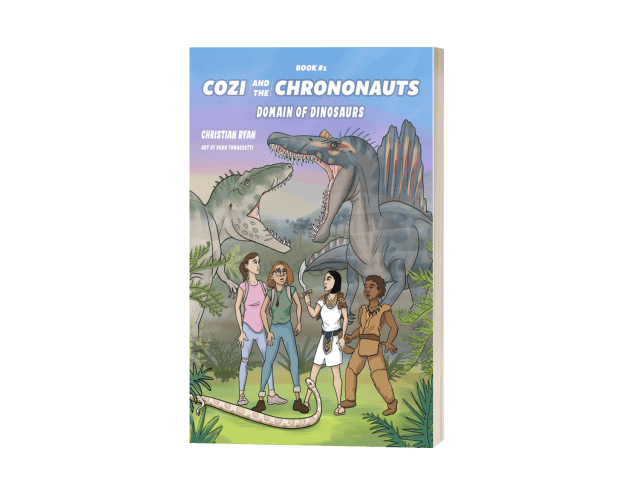
Amidst 12-year-old Cozi Miller’s wavering faith in the Bible, an unexpected twist flings her and her soon-to-be stepsister into a primeval swamp teeming with winged reptiles, legged serpents, and towering dinosaurs eyeing them up for dinner! To survive this perilous realm, they must forge an unlikely alliance with three other time-travelers, all plucked from different eras, and not all of them human!
Embark on an enthralling adventure with Cozi, Rachael, Arsinoe, Elam, and Mr. Noris. Together, they must outsmart colossal, predatory creatures and embark on a quest to unravel a mystery shrouding Earth’s true ancient history!
Buy Your Copy Here
Learn More about the Topics Addressed in the Book:
This web page provides extensive notes and references to support the material in the book Cozi and the Chrononauts #1: Domain of Dinosaurs. It is intended to help parents, teachers and interested scholars who want to explore the biblical and scientific evidence underlying the statements made in the book. However, please note that these references are not exhaustive, and are intended only to point a way into the literature.
Some of the sources were consulted while preparing this book are based on an old-earth perspective. While we do not accept long ages of conventional earth history, these texts provided a great deal of helpful information about the fossil organisms we described or depicted.
Paradigms
Paradigms are big ideas or concepts that we use to better understand the world around us. They often determine what sorts of evidence we are likely to take notice of and even how we understand that evidence. Brand (2006) sets out how we as christians ought to study the natural world with a paradigm that incorporates insights from both science and the Bible.
Brand, L.R. 2006. A biblical perspective on the philosophy of science. Origins [GRI] 59:6-42.
Carnegie Quarry (Dinosaur National Monument)
The Kryster Dinosaur Quarry is based on the Carnegie Quarry, the famous “fossil wall” located at Dinosaur National Monument. Hoesch and Austin (2004) argue that this site represents a transported death assemblage, not a preserved ecosystem:
Hoesch, W. & Austin, S. 2004. Dinosaur National Monument: Jurassic Park Or Jurassic Jumble?. Acts & Facts. 33 (4).
Bahariya Formation and the Kem Kem Beds
The plants and animals seen throughout the Tree Fern Swamp are based on fossils uncovered in the Bahariya Formation of Egypt and the Kem Kem Beds of Morocco. Weishampel, et al. (2004) and Ibrahim, et al. (2020) provide a comprehensive overview of the many fossil discoveries from these regions. A creationist understanding of the Kem Kem Beds can be found in Clarey (2020):
Clarey, Tim. (2015, May 6). Dinosaurs in Marine Sediments: A Worldwide Phenomenon. icr.org
Ibrahim, Nizar, Paul C. Sereno, David J. Varricchio, David M. Martill, Didier B. Dutheil, David M. Unwin, Lahssen Baidder, Hans CE Larsson, Samir Zouhri, and Abdelhadi Kaoukaya. (2020). Geology and paleontology of the upper cretaceous Kem Kem group of eastern Morocco. ZooKeys, 928, 1.
Weishampel, David B; et al (2004). “Dinosaur distribution (Late Cretaceous, Africa).” In: Weishampel, David B.; Dodson, Peter; and Osmólska, Halszka (eds.): The Dinosauria, 2nd, Berkeley: University of California Press. Pp. 604.
Spinosaurus
Spinosaurus is a dinosuar that has left scientists scratching their heads. Some paleontologists (scientists who study fossils) think this dinosaur swam through the water after its prey. Others, however, think it spent most of its time hunting in the shallows, like a giant heron. Even now, scientists are still trying to figure this mystery out. Ibrahim, et al. (2020) and Sereno, et al. (2022) present evidence in favor of their views:
Aquatic Hypothesis:
Ibrahim, Nizar, Simone Maganuco, Cristiano Dal Sasso, Matteo Fabbri, Marco Auditore, Gabriele Bindellini, David M. Martill (2020). Tail-propelled aquatic locomotion in a theropod dinosaur. Nature, 581(7806), 67-70.
Shoreline Hypothesis:
Sereno, Paul C., Nathan Myhrvold, Donald M. Henderson, Frank E. Fish, Daniel Vidal, Stephanie L. Baumgart, Tyler M. Keillor, Kiersten K. Formoso, and Lauren L. Conroy. (2022). Spinosaurus is not an aquatic dinosaur. Elife, 11, e80092.
Flood Legends
Around the planet, there are hundreds of stories from ancient cultures that describe a massive, world-destroying flood in their history. While each story is unique, they share similar themes. Namely, these narratives often depict a special family surviving a worldwide flood intended to wipe out a wicked society. They also mention specific animals and people saved on a wooden vessel, and tell how birds were sent out to see if the floodwaters had receded. These stories even exist in places where major floods are not common.
This suggests these stories aren’t just about local floods. Instead, they seem to tap into a collective memory of a world-altering Flood that ancient ancestors (i.e. Noah’s family) truly experienced. Liguori (2021abc) has created a compilation of Flood traditions from North and South America, all of which bearing striking similarities to the Flood narrative described in the Book of Genesis:
Liguori, N. (2021a, April 13). Flood Legends from the Americas, Pt. 1: Continental United States. Answers in Depth, 16.
Liguori, N. (2021b, April 20). Flood Legends from the Americas, Pt. 2: Canada and the Arctic. Answers in Depth, 16.
Liguori, N. (2021c, April 27). Flood Legends from the Americas, Pt. 3: Mexico to South America. Answers in Depth, 16.
 Cozi and the Chrononauts